

An insight into basso continuo practice in Turin in the 18th century
A visit to the exhibition “Conte Cozio and the Myth of Stradivari”

Two weeks ago, we went to Turin to visit the exhibition “Conte Cozio and the Myth of Stradivari”.
Not only was this exhibition fascinating to us for obvious reasons related to Lutherie and the possibility of seeing famous instruments, but it also presented us with a series of aha moments, both for the connection to our research and for our personal backgrounds. The excitement for that visit is still very lively today!
The exhibition was so rich that it left us speechless, and it cannot be condensed into a single newsletter. We will share in this newsletter insights on basso continuo practice and musical life in Turin in the second half of the 18th century, and leave our personal aha moments and notes on the fabulous instruments we saw for a series of daily notes on our Substack feed.

Ignazio Alessandro Cozio di Salabue was born in Casale Monferrato in 1755.
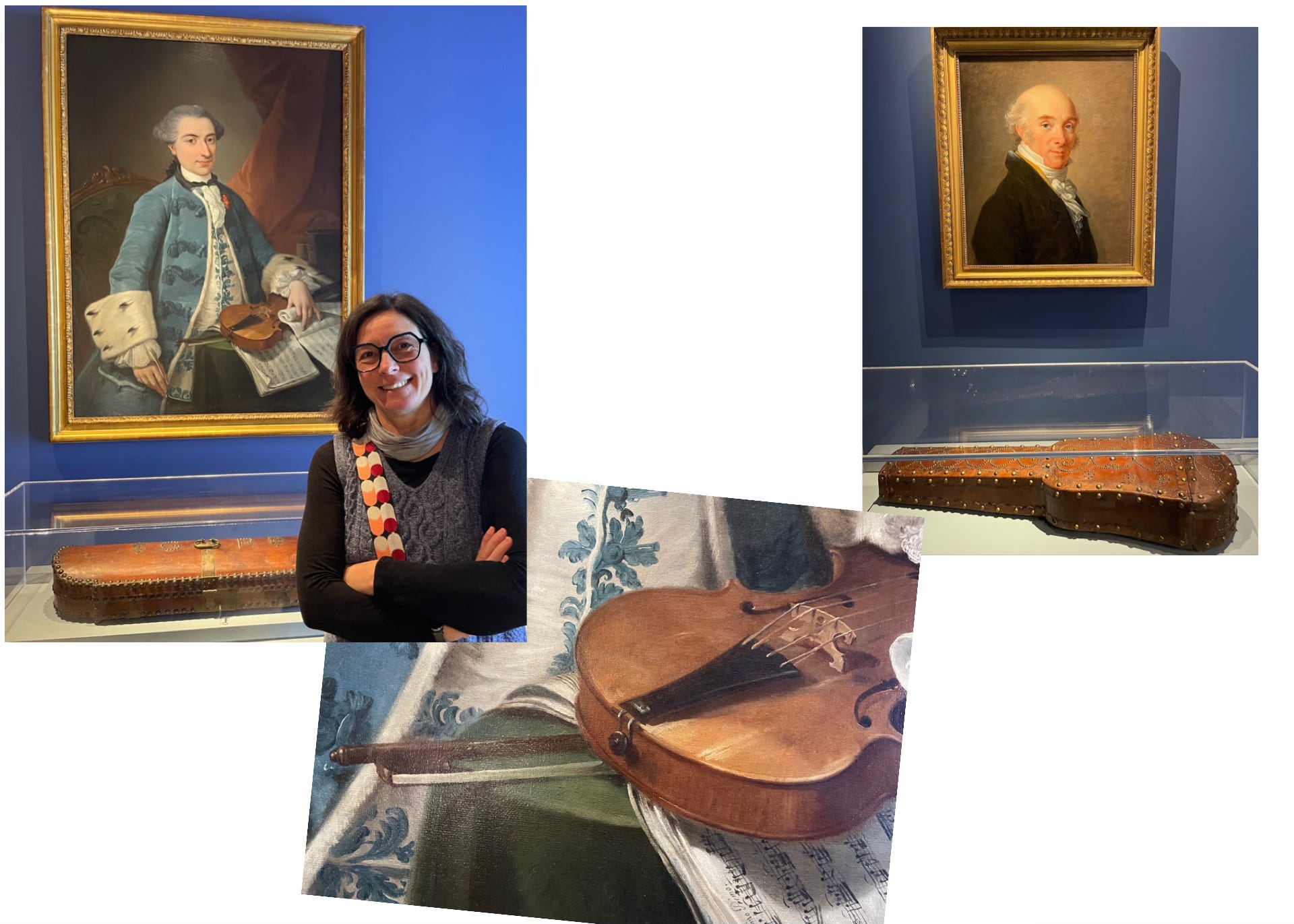
The premature death of his mother and brother in 1760, when he was only 5 years old, helped shape his resolute and resourceful character, which would mark him for the rest of his life. At 13, he entered the Royal Academy in Turin, where he studied various subjects, including dance and music. Among his teachers was the violinist Vittorio Celoniato, a member of a family of musicians and violin makers who were prominent in Turin’s musical life. After completing his studies in 1772, Cozio gave up a military career to assist his father, who died in 1773. Named universal heir, he came into possession of a violin by Nicolò Amati, which he lovingly kept throughout his life. At 18, Ignazio returned to Turin as the wealthy Count Cozio and feverishly dedicated his life to his passion for the violin. A nobleman would not “do the job” with his hands; instead, he would collect precious instruments, trade them, attend events and be acquainted with the virtuoso in town: Viotti and Pugnani, whose violins were exhibited with their original cases in front of the portraits of the players.
A super interesting information on show was the payments list of the Royal Chapel payments for 1768:
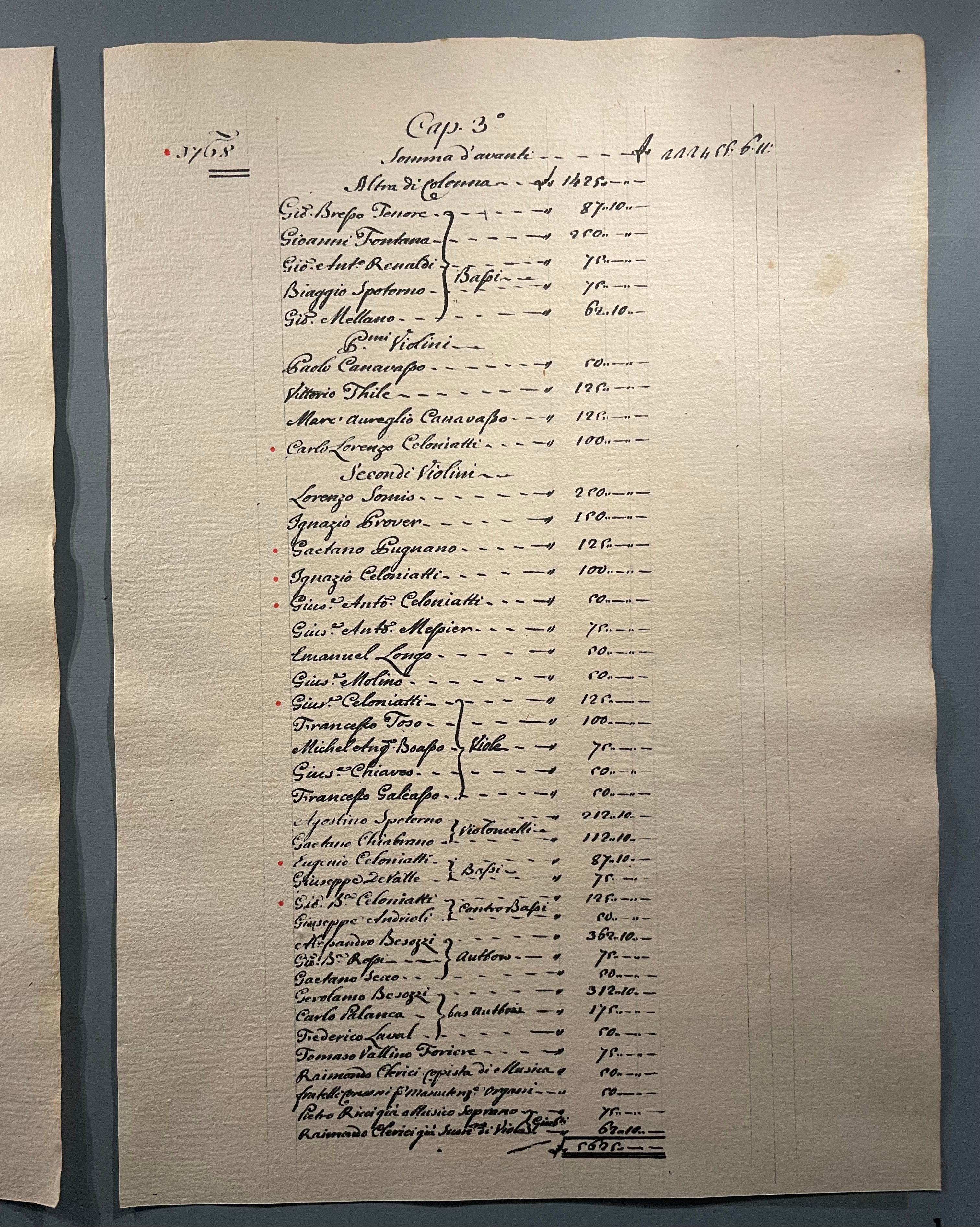
The first violin list doesn’t include the concertmaster, who is mentioned on another page. So there were five altogether. Then they had 8 second violins (among them Gaetano Pugnani), 5 violas, 2 violoncellos, 2 basses AND 2 double basses. 2 oboes and 3 bassoons (bass oboes).
Probably one more viola, listed at the end, was also a copyist.
We can see in the list the Besozzi brothers, oboe and bassoon, and Carlo Palanca, bassoon, a famous woodwind maker and developer of a more modern oboe bore shape.
To a modern eye, this looks like an unusual composition for an orchestra, and a prompt explanation was given in the exhibition by a large format print of a painting by Giovanni Michele Graneri, 1752, showing the Teatro Regio and its orchestra: look at the composition and how they are seated:
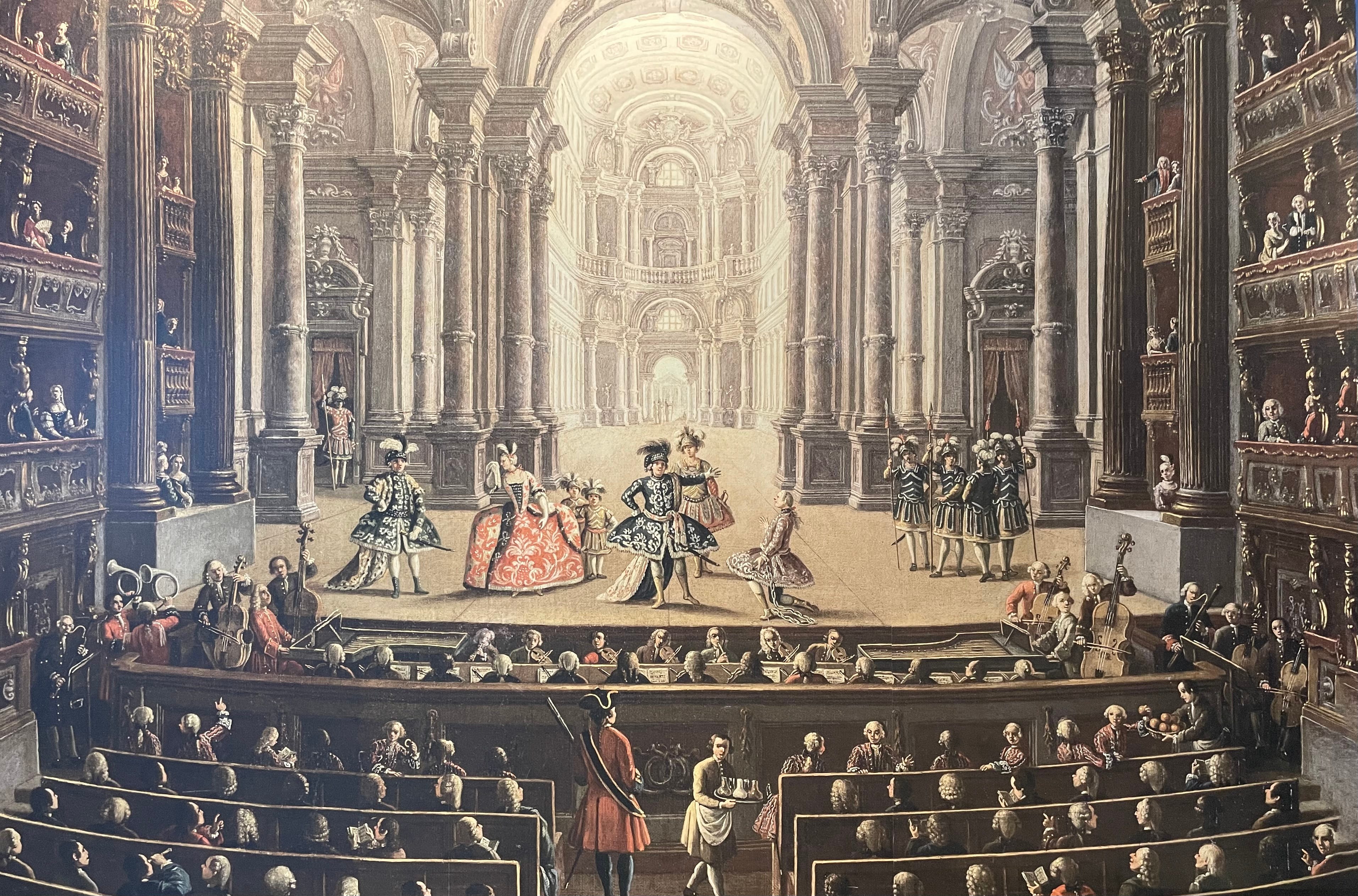
Five first violins at the centre, facing the audience, with oboes in between them (one at the centre, one at our left). Eight second violins and five violas in front of the first violins, shoulders to the audience (and enjoying the show). Two groups of continuo: at the left, a harpsichord, a double bass, a cellist (look at his fantastic playing position!!), two French horns and a bassoon. At the right, a harpsichord, a double bass, a cellist, two other cellists and a bassoon. All the cellists are standing, with their instruments on high wooden endpins, except for the one with the instrument resting on the parapet. It’s right the same line-up of the payment list above, except that there is one more cello and one less bassoon. As to say that bassoons and cellos were interchangeable. I also loved seeing the two different voices opposed, the french horns on the left and the cellos on the right, both grounded by a bassoon.
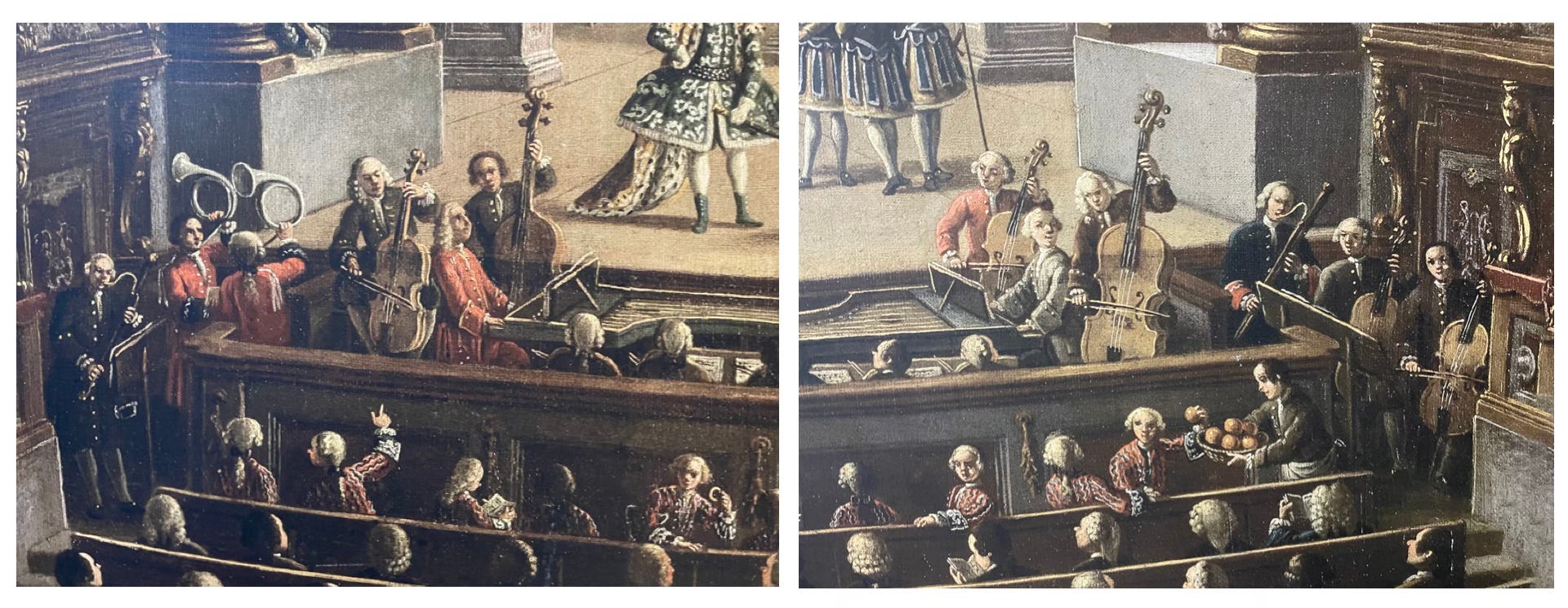
Thank you to Kate Walpole for the help in understanding these information. Kate is studying the composition of the continuo group in this right period in the Hofkapelle Dresden. You can read her opinion on the Violoncello da Spalla here:

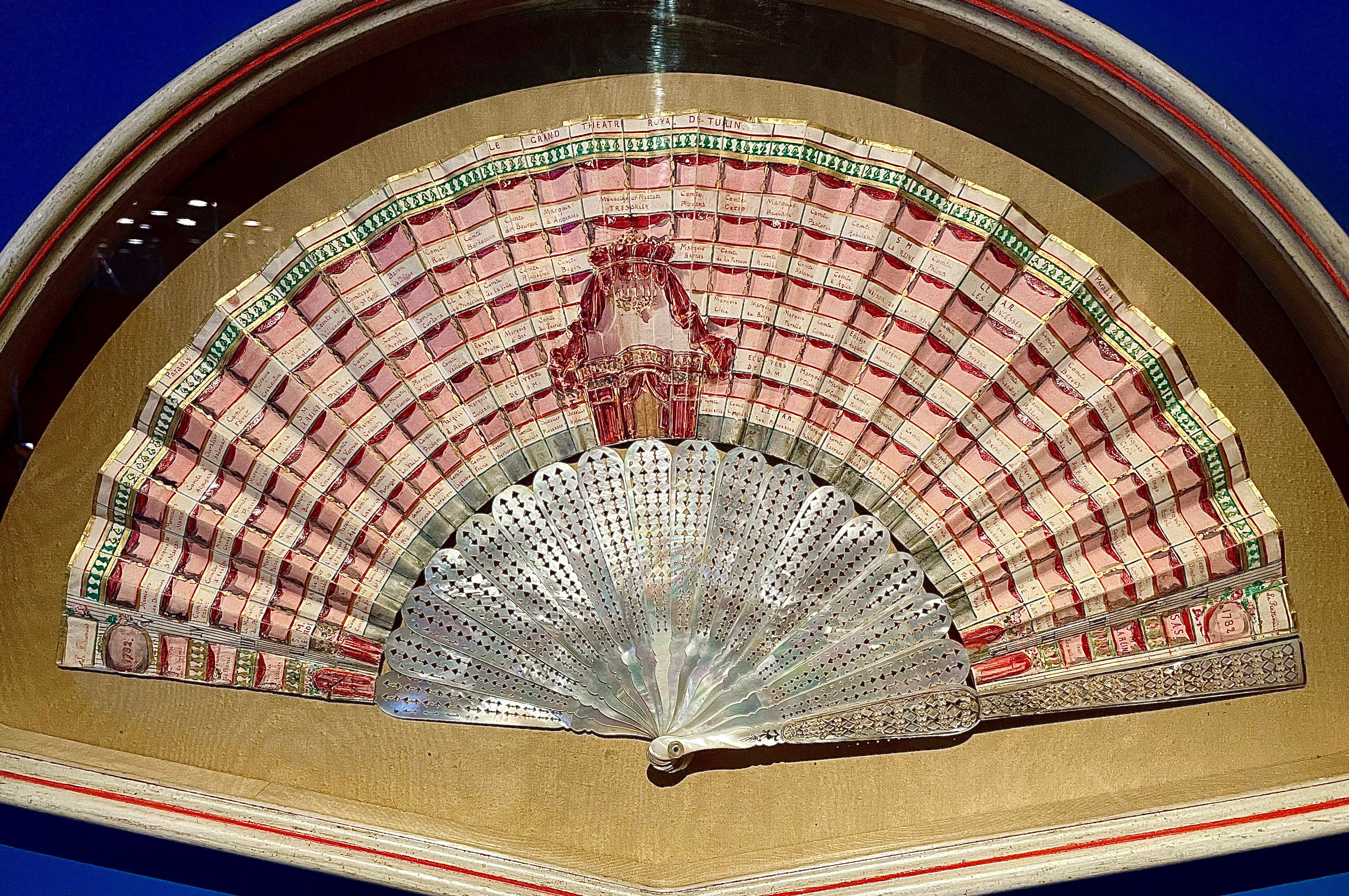
The exhibition was centred on the relationship between Count Cozio and Guadagnini. In 1773, Guadagnini acted as a mediator in helping Cozio acquire 12 violins from Stradivari’s son, Paolo. At the young age of 18, he was able to invest a considerable sum of money: a Stradivari violin at the time was priced at two years of income for a violinist of the Regio Theatre, or as a four-room house in the town of Salabue. In the same year, Cozio’s father dies, and only ten days later, Cozio and Guadagnini sign an exclusivity contract. This collaboration ended after only four years due to divergent ideas about violin-making. Cozio was disappointed because Guadagnini didn’t want to use the forms and drawings of Stradivari, which he acquired in 1775.
From the exhibition notes:
In his inventory drawn up in February 1776, Cozio listed all the instruments he had bought in just three years, collecting in total the remarkable number of 76 violins, 2 violas and 6 cellos.
The list included 13 violins by Antonio Stradivari and 2 by his son Francesco, 6 by Nicolò Amati, 2 by Andrea Guarneri, 11 by Chiaffredo Cappa and no fewer than 42 by Giovanni Battista Guadagnini, to which 5 violins by Carlo Bergonzi were soon added.
[…] In 1801, Cozio temporarily moved to Milan, where, thanks to an effective publicity campaign, he sold 9 violins by Antonio Stradivari, including an outstanding 1724 specimen purchased by Niccolò Paganini.
Between 1803 and 1804, he began writing his ‘memoirs’ (today known as carteggio) and, at the same time, a glossary, which may today be considered the first modern historical-organological treatise.
During those same years, he studied several writings on violin making and engaged in exchanges with makers and scholars on the acoustics of stringed instruments, further deepening his knowledge of their construction. […] In 1823, after the death of his wife, Antonia, Cozio unsuccessfully attempted to sell his entire collection of instruments. He spent his final years between Casale Monferrato and the castle of Salabue, where he died in 1840. […] Count Ignazio Cozio di Salabue died on 15 December 1840 and was buried in the family tomb at the parish church of the castle of Salabue.
Inheritance after inheritance, the collection was dispersed. A part of it was acquired between 1841 and 1844 by the famous Piedmontese dealer Luigi Tarisio, later passing to Vuillaume and ending up in the Hill family collection.
The remaining part, including the carteggio and the fondo stradivariano, was sold in 1920 to the luthier Giuseppe Fiorini, mentor of a young Ferdinando Sacconi.
In 1930, Fiorini donated the ‘fondo stradivariano’ together with Cozio’s entire ‘carteggio’ to the Civic Museum of Cremona, while retaining the instruments.
After 1973, Cozio’s ‘carteggio’ was deposited in the Biblioteca Statale di Cremona for reorganisation and cataloguing. In 2013, the Fondo Stradivariano was transferred to the Museo del Violino in Cremona, where it is still preserved today.
The carteggio is digitised and available at this link.
I will post pics of some of the instruments on show in our Notes in the next few days, so if you follow us, you should see them on your Substack feed.
If you are interested in pre-ordering the show catalogue, write to editions Il Salabue. The price is still unknown, so you are not committing to buy it, but you will be notified when the book is ready.
Updates from our workshop
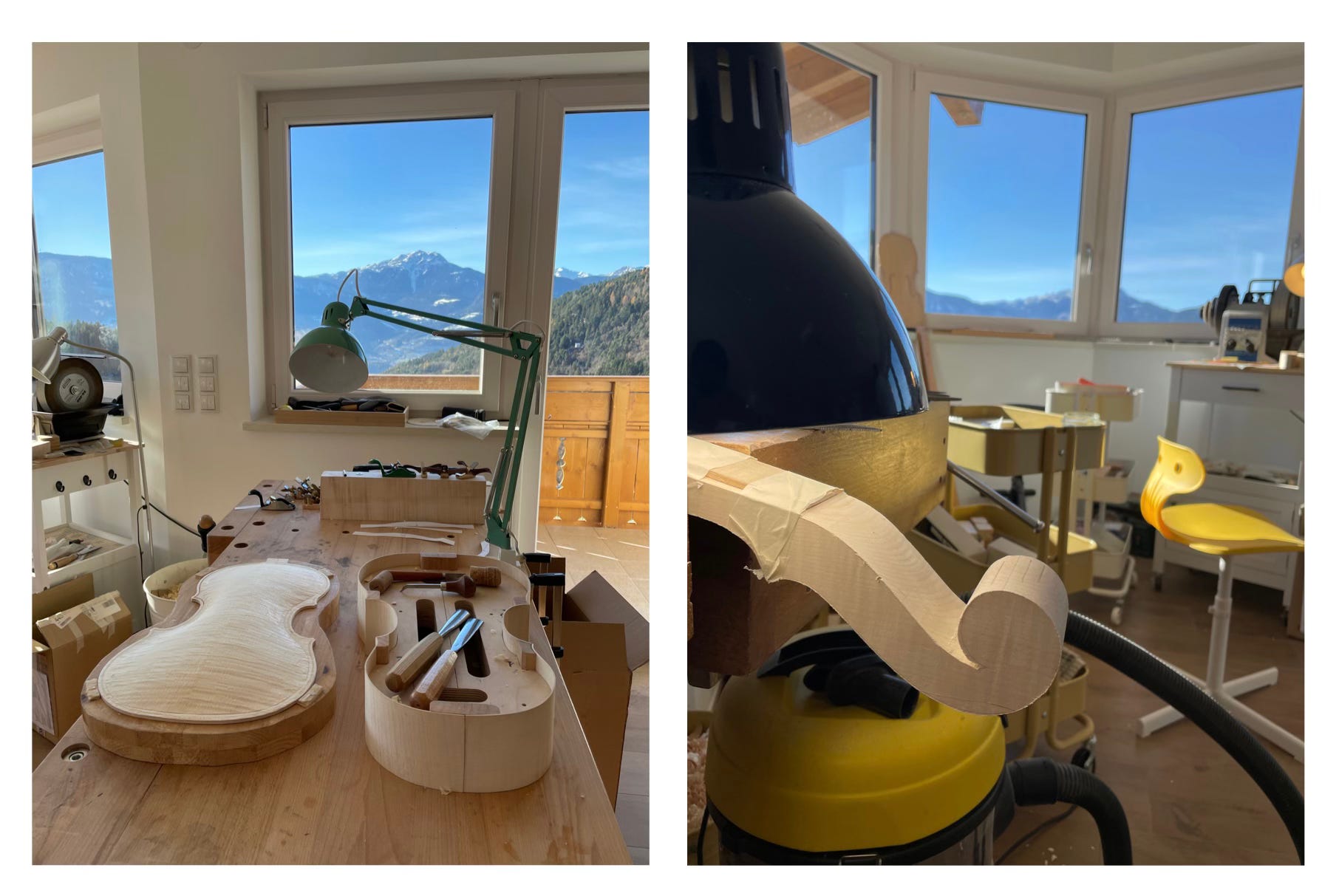
We’re both on da spalla making, but with two different ideas and two different processes! Wait and see!
Featured video of the week
Wenhan Jiang, now principal viola of the Royal Philharmonic Orchestra, rehearsing before a recital in Murcia, Spain. Wenhan’s Violoncello da Spalla was made by Daniela in 2023.
Are you a luthier interested in making a Violoncello da Spalla?
In the archive of this newsletter I documented the whole process, sharing measures and templates. You can check the index and some posts at this link, and if you subscribe to a paid plan, you have instant access to all posts and a private chat where you can ask me any question.
